
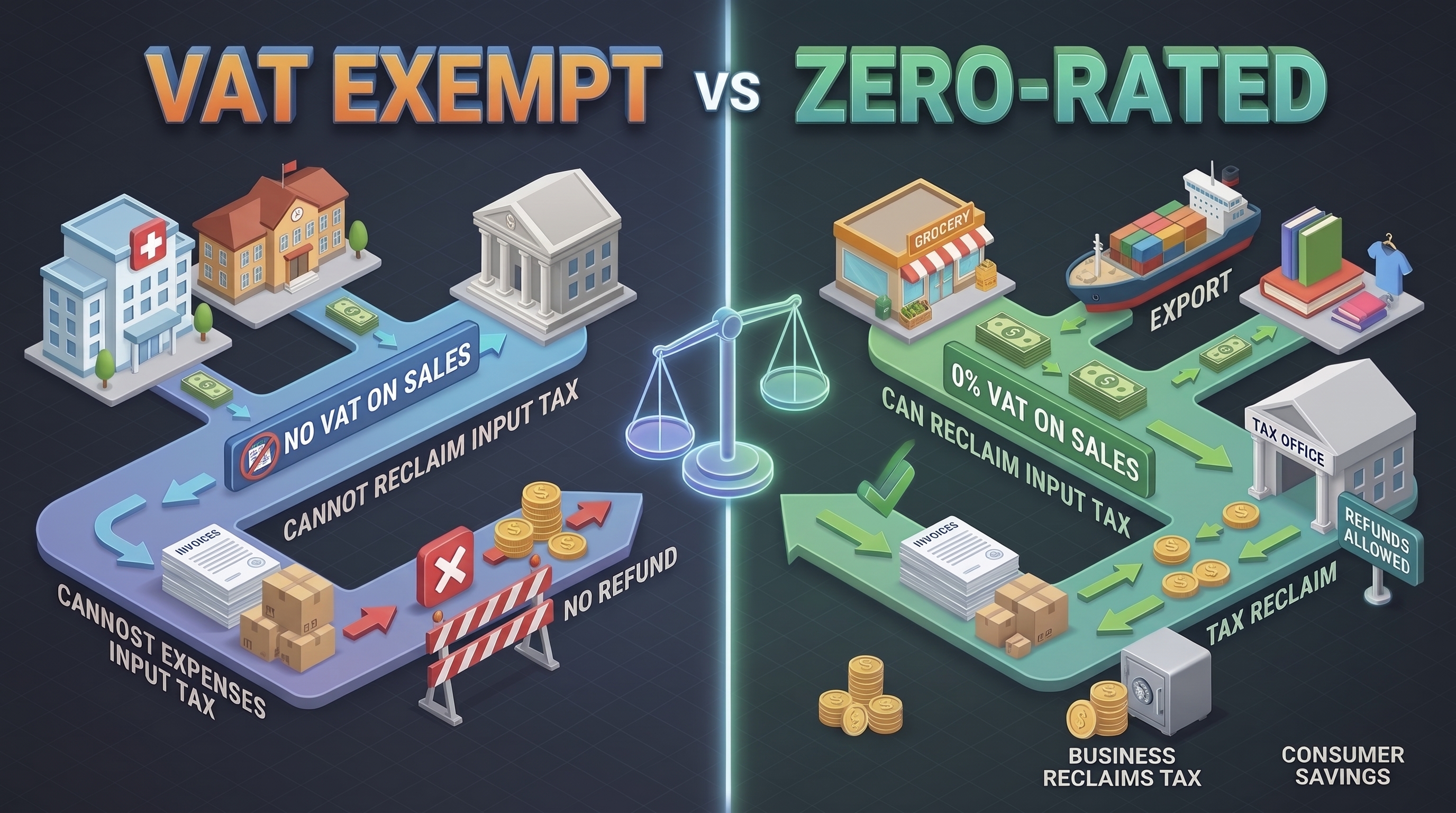
At first glance, VAT-exempt and zero-rated supplies may appear identical. In both cases, the customer pays no VAT on the transaction. However, the difference lies in how businesses treat VAT incurred on their purchases.
What is the difference?
A VAT-exempt supply is not subject to VAT. Also, businesses making exempt supplies generally cannot recover input VAT attributable to those supplies. Such VAT becomes part of their operating costs and may ultimately influence their selling prices.
A zero-rated supply, on the other hand, is subject to VAT at 0%. Although the customer pays no VAT, the supplier can recover qualifying input VAT, subject to statutory conditions.
What does the Nigeria Tax Act, 2025 say?
The Nigeria Tax Act, 2025 provide for exempt and zero-rated supplies respectively.
Examples of exempt supplies include baby products, locally manufactured sanitary products, land and buildings, and shared passenger road-transport services.
Zero-rated supplies include basic food items, medical and pharmaceutical products, educational books and materials, and qualifying exported goods and services.
So, Who Benefits?
The distinction between VAT exemption and zero-rating has implications for consumers, businesses and the government. For;
Consumers
They benefit directly from both classifications because no VAT is charged on the final purchase. However, the indirect benefit may differ. With zero-rated supplies, businesses can recover qualifying input VAT incurred on their purchases. This reduces the amount of unrecovered VAT being transferred into the cost of production and, the selling price.
With exempt supplies, however, businesses generally cannot recover input VAT attributable to those supplies. Such unrecovered VAT becomes part of their operating costs and may be passed on to consumers through higher prices.
Therefore, although consumers pay no VAT directly under either classification, zero-rating may offer greater economic relief by reducing the tax burden embedded in the supply chain.
Businesses
For businesses, zero-rating generally provides a more favorable VAT position because qualifying input VAT can be recovered, thereby reducing production costs and protecting profit margins. In addition, businesses making exempt supplies may have to absorb VAT incurred on their purchases as an operating expense. This can increase their cost of production, reduce profitability or contribute to higher selling prices.
This distinction is particularly important for businesses with significant taxable inputs, as the inability to recover input VAT may create a substantial cost burden even when their own sales are not subject to VAT.
The Government
From the government's perspective, both classifications represent deliberate policy choices that provide VAT relief to particular goods and services. However, their revenue implications differ.
Under zero-rating, the government does not collect VAT on the final sale and may also be required to refund qualifying input VAT incurred by the supplier. This makes zero-rating a more extensive form of VAT relief across the supply chain.
Under exemption, although VAT is not collected on the final sale, VAT incurred at earlier stages generally remains embedded in the supplier's costs. And, some VAT revenue may still be retained within the supply chain.
The choice between the two classifications therefore involves balancing government revenue considerations against affordability, business competitiveness and the broader economic objective of making essential goods and services more accessible.
The distinction between VAT exemption and zero-rating goes beyond what appears on an invoice. It determines whether VAT incurred along the supply chain can be recovered or becomes an additional business cost. Therefore, businesses should pay close attention to the classification of their supplies and the corresponding input VAT treatment to ensure accurate VAT reporting and compliance.